NOAA Ocean Exploration and AOML Collaborate to Release First eDNA Data from Okeanos Explorer
May 5, 2026
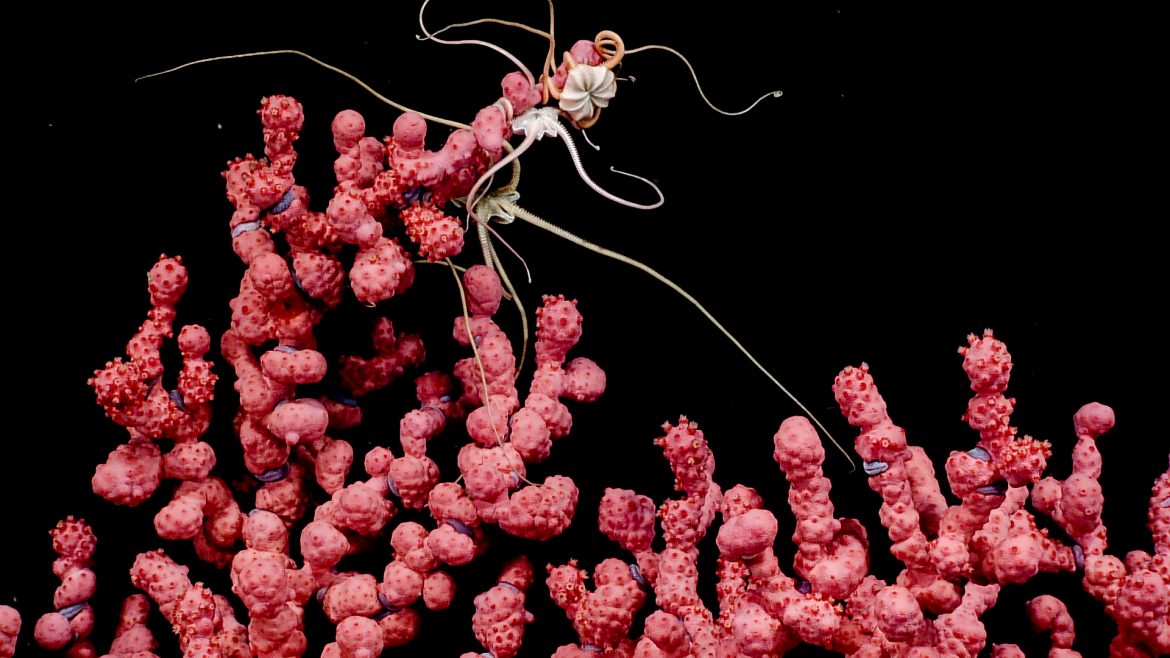
NOAA Ocean Exploration's recently released environmental DNA data help us better understand what lives in the deep ocean. Among these data is evidence of a wide variety of deep-sea organisms, including deep-sea corals like Paragorgia arborea, seen here. Image courtesy of NOAA Ocean Exploration, 2023 Shakedown + EXPRESS West Coast Exploration.
Can we learn about life in the deep ocean even if we don't see it? Yes we can. Thanks to environmental DNA (eDNA), we no longer need a visual sighting to know what's been in the neighborhood.
In April, NOAA Ocean Exploration, in partnership with NOAA's National Systematics Laboratory at the Smithsonian National Museum of Natural History, the Northern Gulf Institute, and the Atlantic Oceanographic and Meteorological Laboratory, released
its first deep-sea environmental DNA (eDNA) datasets. These biological data were collected during expeditions on NOAA Ship Okeanos Explorer in the Pacific and Atlantic oceans between 2021 and 2023.
Raw sequences are available from the National Center for Biotechnology Information (NCBI) (BioProject: 1284389).
Organism identifications are available from the Ocean Biodiversity Information System (OBIS). By sharing these economically and scientifically critical data through globally accessible repositories, the partners hope to enable further deep-ocean discoveries and understanding to address current and emerging science and management needs. As part of the NOAA Omics Seminar Series, NOAA Omics and the NOAA Library are hosting a
webinar about the release of these data on May 28 at noon EDT.
Registration is required.
Explore eDNA and its applications
This story is adapted from NOAA Ocean Exploration. See the full story
here.